In the late 1980s I was struggling to unravel the strands of Gavin families all living and working on the Downs in the vicinity of Dalby. I had connected with another researcher by snail mail and slowly but surely we made progress on figuring out these families. Carmel died over twenty years ago but I still think of her and how we collaborated on this challenge…how much easier it would have been via email and with digitised records, but perhaps less fun. We had gone to the same school in Brisbane, some 20+ years apart but somehow we were simpatico.

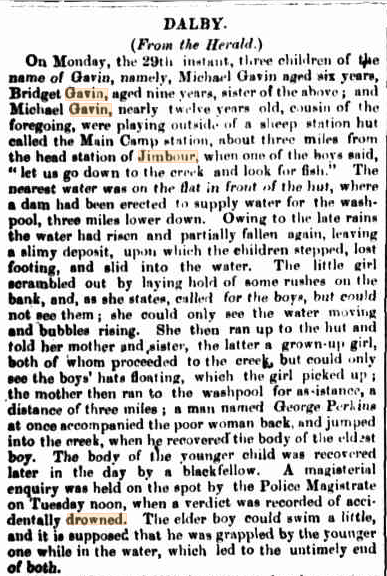
Among my earliest family history discoveries was the story of two boys who drowned on Jimbour station back in its early days[iii]. The were cousins aged 12 and 6 and both named Michael Gavin. The inquest[iv] identifies the parents of Bridget and the younger Michael as Stephen and Anna (aka Honora Mulkerrin) Gavin. The twelve year old Michael was the son of Mark and Anna Gavin.
Mark Gavin/Gavan was a convict, one of those known as an exile, who was granted his ticket of leave on arrival in 1849 and sent to Mr Bell at Jimbour to work as a shepherd. Mark’s brothers Thomas and Stephen emigrated as remittance passengers with their families in 1859 and 1862 respectively. One of Mark and Anna’s children emigrated with Mark’s brother, Thomas, and all lived and worked at Jimbour, at least initially. The drowned six year old had arrived as a baby of one. Stephen and his wife Honora are the only family I’ve encountered returning to Ireland, and I feel they must have had some financial support to do so. This only became apparent because the family re-emigrated to Queensland in 1874.
The newspaper story of the “melancholy and fatal accident” was comprehensive.[v] Three children, Michael Gavin 12, Bridget Gavin, 9 and Michael Gavin 6, were playing at bullocky near the water at the Maia Camp outstation on Jimbour on Monday 29 October 1866. They slipped, lost their footing and slid into the water. The little girl, Bridget, managed to escape by grabbing some rushes and could see no sign of her brother and her cousin. Just imagine a nine-year old’s panic as she ran to the hut to fetch her mother, and the distress of her mother as she ran another three miles to the washpool for assistance. The bodies were recovered later by George Perkins and an unnamed Aboriginal man.

The two young lads are remembered on a memorial plaque at Jimbour. These Gavin families had already experienced so many hardships to survive the Great Famine, and then sailing to Australia. Theirs was true pioneer courage. There were new members of Mark’s Gavin’s family born in Australia, baptised by Ipswich’s travelling priest, Fr McGinty, who rode many miles across Moreton Bay to care for his own flock.

Jimbour remains a long-standing Queensland property which opens its doors to visitors these days. It’s many years since I looked at the area, but not the house or garden, and it had been on my long-term visit list. I finally made it in 2023 when we visited for the Opera and to search the old cemetery, where I found the memorials I’d long wanted to see. You can read some of the history of the house at: https://jimbour.com/history/
Sadly, the Historic Jimbour Cemetery was rather bedraggled when we found it.
Translation: A station in this context is the equivalent of an American ranch.
[i] http://queenslandplaces.com.au/jondaryan
[ii] These books were found by John Eggleston in the late 1980s. There is an index of names available at the Genealogical Society of Queensland and also Queensland State Archives (in a book near the door).
[iii] These stories are easy enough to find now that Trove has digitised the newspapers but in the late 1980s, it would have been impossible to find this story without the indexing work of the Toowoomba and Darling Downs Family History Society.
[iv] Page 3, column 6. The inquest into the death of Michael Gavin (12) and Michael Gavin (6) is in Queensland State Archives at JUS/N13 66/174.
[v] Darling Downs Gazette of 3 Nov 1866
Share this:
- Click to share on Twitter (Opens in new window)
- Click to email a link to a friend (Opens in new window)
- Click to share on Pinterest (Opens in new window)
Book reading: Jondaryan Station: the relationship between pastoral capital and pastoral labour 1840-18905 January, 2011In “Dorfprozelten research”
J is for Broome’s Japanese Cemetery and Jimbour13 April, 2023In “A to Z 2023”
Genea-learning and touring20 August, 2017In “Darling Downs” Posted in A to Z 2012, Darling Downs, Family History, Gavin Family Queensland, Irish family history, Kunkel Family History, Queensland, Queensland RailTagged A to Z challenge 2012, Bridget Gavin, Gavin, George Michael Kunkel, Honora Gavin, Jimboomba, jimbour, jondaryan, Julia Celia Gavin, Kunkel, Mark Gavan, Michael Gavin, Stephen Gavin
Post navigation
I investigates Ireland, Inishail, and Ipswich (Qld)
My A to Z challenge: what’s it all about about?
5 thoughts on “Jogging into Jondaryan, Jimbour and Jimboomba”
Crissouli How sad for little Bridget, how distraught she must have been, along with her family. As always, I’m fascinated by your family stories. Thank you for sharing, Pauleen.Like Reply
Joan Reading your history/travelogue has become my hot-tea-in-hand morning pastime. The family stories provide a global link that somewhat mirrors my own family history across the seas. But what really takes my time is switching back and forth between maps(google) and links. I never knew very much about Australia, except that my uncle was stationed there during WWII and its the home of kangaroos. You, however, are giving me the grand tour!Like Reply
cassmob hi Joan, Glad you’re enjoying your morning-tea-tours even if it means a longer tea break. I think we all learn from blogging about our common experiences and thoughts and the differences as well. Where was your uncle posted do you know? Hope you continue to enjoy your Grand Tour. PauleenLike Reply
- Pingback: Ancestral Places Geneameme | Family history across the seas
Leave a comment
This site uses Akismet to reduce spam. Learn how your comment data is processed.
Search this blog in the box below
Search for: 
Subscribe by email if you agree with my privacy policy.
You may unsubscribe at any time.
Email Address:


Follow Me
SEARCH BY CATEGORY HERE
SEARCH BY CATEGORY HERE
Recent posts
- Remembrance Day 2023
- Z is for Zöller graves
- Y is for Yungaburra
- W is for Wallumbilla and Winton
- V is for Victoria
Powered by Translate
Archives
Archives
 Family history across the seas

Such a sad story and terrible for the surviving child. It’s great to see you post appearing in my inbox. I’m not resting but preparing for next year’s A to Z.
LikeLike
That’s impressive prior planning Linda.
LikeLike
I’m typing up all my husband’s letters to his family while he was travelling to and living in England for three years in the 1960s. It is an important historical record I think. He wrote at least a letter or aerogramme every month, sometimes more. My eyes are nearly falling out trying to read the tiny writing. How I will turn it into an A to Z I’m not sure yet but I think I will write it in my own words with extracts from his letters. I have the added advantage of being able to ask him to elaborate on certain parts. It was such an amazing time in social history, especially in London for a young Australian.
LikeLike
Oh dear, that’s awful. Life was so precarious. Kylie
LikeLike